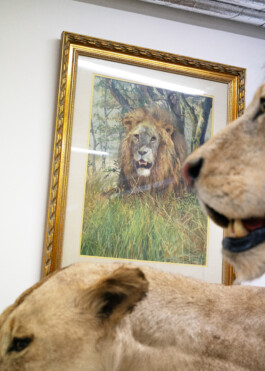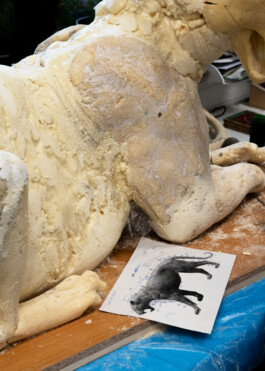
None of the creatures in this work are animals. All that remains of the actual being is an image, in skin and feathers, here and there a tooth or a beak, preserved in a moment of liveliness. Taxidermy is the process of the preparation and setup of animal bodies for purposes of presentation. From taxis for arrangement and derma for skin. The bodies of animals thus become objects, hundreds of thousands of them are kept in the halls and depots of natural history museums.
During my visits to the museums, the usual hustle and bustle of visitors has died down, the hallways and collections are now deserted. When I pause for a moment and remain motionless amidst the unblinking animals, they seem no less alive than I am. During my work, I repeatedly feel a sense of vagueness towards these specimens. After my visit to the taxidermy workshop, the pitilessness of their origin, the immediacy of death and the ruthlessness of the taxidermic process are inscribed in their form. At the same time, over the course of my work I get to know the people and places that shelter these objects. Their attentiveness and precision, the craftsmanship and the immense knowledge of the animal body required to create such specimens. The carelessness that humans usually show towards the animal body, on the bumper of their car or in the supermarket fridge, seems to be reversed here. Every body is worth preserving and keeping, from the hundreds of native songbirds to a mother elephant and her calf. Their bodies preserve for us a document of the seemingly endless and timeless splen- dour of the earth. Yet I experience their physical form as astonishingly fragile, as if it is in a constant battle against its own decay. Colours fade, hair falls out and dust nests in their skin.
Under the clinical neon light of the depot, between shelves and display cases, the animals seem all the more out of place. I experience them almost naturally in the diorama, in the recreation of the habitat they inhabited as living beings. The dioramas create an striking illusion of a natural environment. This illusion seems so perfect that it makes me briefly forget its artificiality and I immerse myself in worlds that would otherwise remain hidden from me as a human. But there are no leaves blowing in the wind, the clouds are painted firmly on the walls and the glass of the diorama prevents any touch. Just as none of the specimens is really an animal, these rooms are merely an image of nature, a glimpse into a distant wilderness.
Sometimes I find myself wishing that the creatures in front of me could spring back to life, shake off the decades-old dust and return to the wilderness they were once taken from. But most of the animals I encountered in the museums would return to zoo enclosures, appartements or the roadside. The nature I dreamed them back into harbours fewer of their species every day. The walls of our world are closing in on theirs. Soon only specimens of many species will remain in museums. The richness of nature preserved as enchanting, rigid memories.
At the beginning of the 19th century, an estimated three to five billion passenger pigeons of the species ectopistes migratorius lived in North America. For thousands of years these nomadic birds travelled along the American East and the Great Lakes. Their flocks were so enormous that in some places they are said to have darkened the sky for days on end. It seemed unimaginable that this endless stream in the sky would not be part of the land forever. In 1914, the last passenger pigeon, named Martha, died at the Cincinnati Zoo. Within a few decades, her species had been hunted to extinction. Martha‘s body was taxidermied and now resides in the Smithsonian Museum in Washington D.C..
The conservationist Aldo Leopold wrote in 1947 on the occasion of the dedication of the memorial to her species:
»Men still live who, in their youth, remember pigeons. Trees still live who, in their youth, were shaken by a living wind. But a decade hence only the oldest oaks
will remember, and at long last only the hills will know. There will always be pigeons in books and in museums, but these are effigies and images, dead to all hardships and to all delights. [...]
They live forever by not living at all.«
Keine der Kreaturen in dieser Arbeit ist ein Tier. Von dem eigentlichen Wesen ist nur ein Abbild geblieben, in Haut und Federn, hier und da ein Zahn oder ein Schnabel, in einem Moment der Lebendigkeit konserviert. Das Präparieren und Arrangieren von Tierkörpern zu Präsentationszwecken bezeichnet man als Taxidermie. Von taxis für Anordnung und derma für Haut. Die Körper der Tiere werden so zu Objekten, zu Hundert-tausenden harren sie aus in den Hallen und Lagern der naturkundlichen Museen.
Während meiner Besuche in den Museen ist der übliche Trubel der Besucher*innen verstummt, die Hallen und Sammlungen sind nun menschenleer. Wenn ich kurz innehalte und unbewegt inmitten der starren Tiere verweile, scheinen sie nicht weniger lebendig zu sein als ich. Immer wieder spüre ich während meiner Arbeit eine Unklarheit gegenüber den Präparaten. Spätestens nach meinem Besuch in der Präparationswerkstatt, ist in ihre Gestalt die Schonungslosigkeit ihres Ursprungs ein- geschrieben, die Unmittelbarkeit des Todes und die Unbarmherzigkeit des präparatorischen Prozesses. Gleichzeitig lerne ich im Laufe meiner Arbeit die Menschen und Orte kennen, die diese Objekte beherbergen. Ihre
Achtsamkeit und Genauigkeit, die Kunstfertigkeit und das immense Wissen des tierischen Körpers, das nötig ist um solche Präparate zu schaffen. Die Achtlosigkeit die der Mensch sonst dem tierischen Körper entgegenbringt, an der Stoßstange seines Autos oder im Kühlregal des Supermarktes, scheint hier umgekehrt zu werden. Jeder Körper trägt den Wert konserviert und aufbewahrt zu werden, die Hunderten heimischen Singvögel ebenso wie eine Elefantenmutter mit Kalb. Ihre Körper bewahren uns ein Dokument der scheinbar endlosen und zeitlosen Pracht der Erde. Doch ihre physische Gestalt erlebe ich als erstaunlich fragil, als steht sie im stetigen Kampf gegen den eigenen Verfall. Farben verbleichen, Haare fallen aus und Staub nistet sich in ihre Haut ein.
Im klinischen Neonlicht des Depots, zwischen Roll- regalen und Vitrinen wirken die Tiere umso deplatzierter. Fast schon natürlich erlebe ich sie im Diorama. In der Nachempfindung jenes Habitats, das sie als Lebewesen bewohnt haben. Die Dioramen schaffen eine eindrucksvolle Illusion eines Naturraumes. So perfekt scheint diese Illusion, dass sie mich kurz ihre Künstlichkeit vergessen lässt und ich tauche ein in Welten, die mir als Mensch sonst verborgen bleiben.
Doch kein Blatt weht im Wind, starr sind die Wolken auf die Wände gemalt und das Glas des Dioramas verwehrt jede Berührung. So wie keines der Präpararte wirklich ein Tier ist, sind auch diese Räume lediglich das Abbild einer Natürlichkeit, ein Einblick in eine ferne Wildnis. Manchmal ertappe ich mich bei dem Wunsch, die Kreaturen vor mir könnten wieder zum Leben erwachen, den Jahrzehnte alten Staub abschütteln und in jene Wildnis zurückkehren, aus der sie einst genommen wurden. Doch die meisten der Tiere, denen ich in den Museen begegnete, würden zurückkehren in Zoogehege, in Wohnungen oder an einen Straßenrand. Die Natur, in die ich sie zurückträumte, beherbergt jeden Tag weniger ihrer Spezies. Enger rücken die Wände unserer Welt an die ihre. Schon bald bleiben von vielen der Arten nur Präpa- rate in Museen. Der Reichtum der Natur konserviert als hinreißende starre Erinnerungen.
Anfang des 19. Jahrhunderts lebten schätzungsweise drei bis fünf Milliarden Wandertauben der Art Ectopistes migratorius in Nordamerika. Die nomadischen Vögel zogen für Jahrtausende entlang des amerikanischen Ostens und der Great Lakes. Ihre Schwärme waren von so enormer Größe, dass sie mancherorts den Himmel für mehrere Tage verdunkelt haben sollen. Unvorstellbar schien es, dass dieser unendliche Strom am Himmel nicht für immer Teil des Landes sein würde. 1914 starb die letzte Wandertaube, genannt Martha, im Zoo von Cincinnati. Innerhalb weniger Jahrzehnte war ihre Art bis zu Ausrottung gejagt worden. Marthas Körper wurde präpariert und steht heute als Taxidermie im Smithsonian Museum in Washington D.C..
Der Naturschützer Aldo Leopold schreibt 1947 anlässlich der Einweihung des Mahnmals an ihre Spezies:
»Es gibt noch Menschen, die sich an die Tauben in ihrer Jugend erinnern. Auch Bäume leben noch, die in jungen Jahren von einem lebenden Wind gerüttelt wurden. Aber in zehn Jahren werden nur die ältesten Eichen eine Erinnerung behalten, und zuletzt werden es nur die Hügel noch wissen.
Es wird immer Tauben in Büchern und Museen geben, aber dies sind bloß Abbilder, tot für alle Mühen und Freuden. [...]
Sie leben ewig, indem sie überhaupt nicht leben.«